A follow-up to “A Pragmatic Path Forward: Why Somalia Needs a Hybrid Electoral Approach”
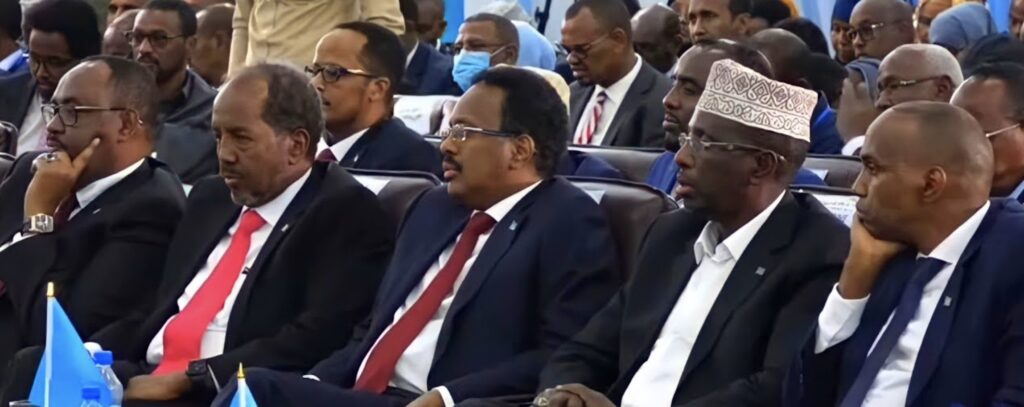
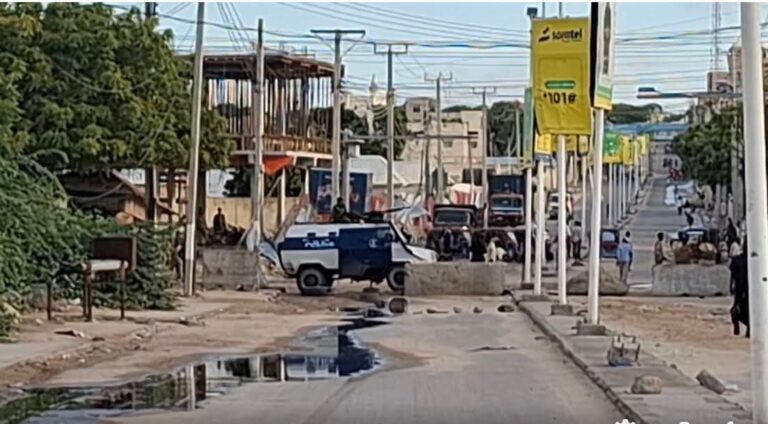
On February 1, 2026, what was supposed to be a breakthrough moment for Somali national unity collapsed before it began. Aircraft carrying security personnel for Puntland President Said Abdullahi Deni and Jubaland President Ahmed Madobe were ordered to turn back mid-flight as they approached Mogadishu for long-awaited national dialogue talks. The federal government accused the regional leaders of attempting to bring over 100 armed guards each, far exceeding the agreed limit of 30 uniformed and 10 civilian personnel per president. Puntland and Jubaland accused Villa Somalia of deliberately sabotaging negotiations it never intended to succeed. The United Nations, European Union, and international partners issued urgent appeals for de-escalation. As I write, the talks remain suspended, and the path to credible elections before President Hassan Sheikh Mohamud’s May 2026 mandate expires has narrowed dramatically.
This crisis did not emerge from nowhere. It is the culmination of everything that went wrong-and some things that went right since December. On December 25, 2025, Mogadishu held its first direct local elections in 56 years. For those of us who advocated a cautious, sequenced approach to electoral reform, that day offered both vindication and concern. The elections proceeded peacefully under heavy security, with over 230,000 citizens casting ballots for 390 district council seats. Yet the process unfolded exactly as critics warned: boycotted by the opposition, rejected by two major federal member states, and dismissed by analysts as “symbolic” rather than transformative. One day later, Israel’s recognition of Somaliland added a new sovereignty crisis to an already fractured political landscape. The question is no longer whether Somalia can hold credible national elections-it is whether the country can avoid another destabilizing political crisis.
What the Mogadishu Vote Revealed
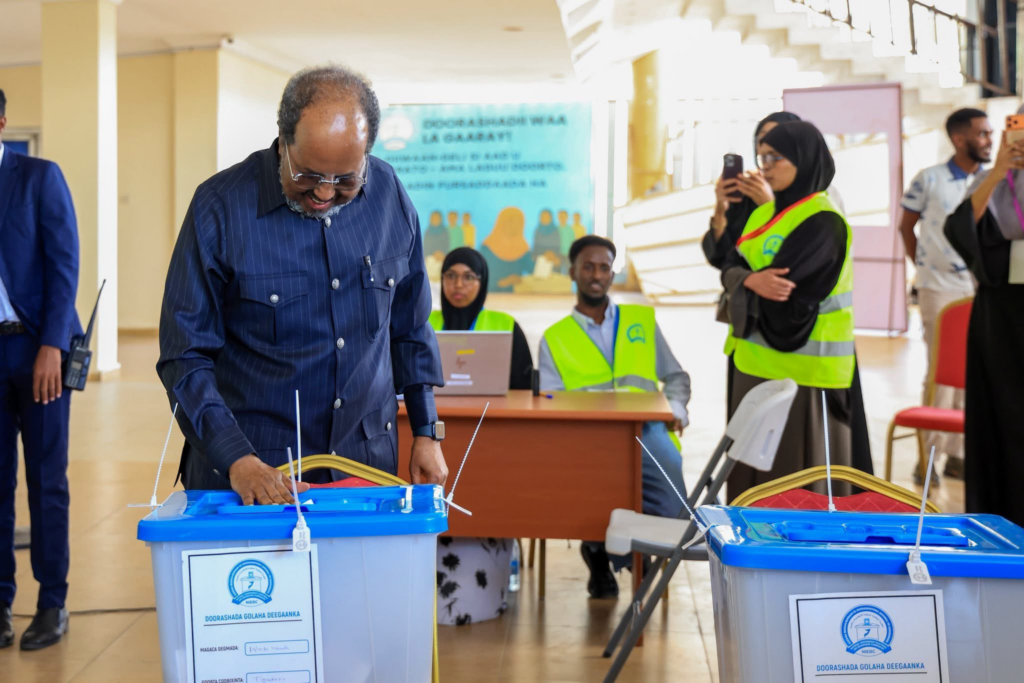
In my previous article, I argued that Somalia should implement direct elections at the local level while maintaining indirect voting for national leadership, a hybrid model that would allow democratic experimentation without gambling national unity. The December 25 vote partially vindicated this logic. Local elections in a controlled urban environment proved technically feasible. The National Independent Electoral and Boundaries Commission deployed 523 polling stations across 16 districts, processed ballots from 20 political parties, and announced results within days. No major security incidents occurred, despite Al-Shabaab’s continued presence just 60 kilometers from the capital.
But the vote also exposed the limits of proceeding without consensus. Of the approximately 900,000 registered voters, only around 233,000 cast ballots-a turnout that reflects not logistical failure but political boycott. Former presidents Sheikh Sharif Sheikh Ahmed and Mohamed Abdullahi “Farmajo” Mohamed both condemned the process. The Somali Salvation Forum, the main opposition coalition, rejected participation. Most critically, Puntland and Jubaland-two of the most populous and militarily significant federal member states-refused to recognize the electoral framework entirely. Earlier in December, opposition leaders convened in Kismayo and threatened to organize parallel national elections, a move that would formalize the country’s political fragmentation.
The government framed the Mogadishu vote as proof of concept. President Hassan Sheikh declared it “a powerful statement of Somalia’s recovery.” The electoral commission chairman praised the peaceful conduct and transparent counting. Yet international partners offered only muted responses. The United States ambassador to the UN expressed “deep concern” over Somalia’s deteriorating security situation. The African Union, preoccupied with funding shortfalls for its peacekeeping mission, offered no endorsement. When the country’s most important security partners decline to celebrate a democratic milestone, the signal is clear: technical success does not equal political legitimacy.
Hassan Sheikh’s Shifting Electoral Vision
Understanding how Somalia arrived at this impasse requires tracing President Hassan Sheikh Mohamud’s evolving positions on electoral reform. When he returned to power in 2022, he pledged to transition Somalia to universal suffrage, a promise that resonated with citizens exhausted by the corrupt, clan-based system that had produced endless political crises. In March 2024, his government secured parliamentary approval for constitutional amendments that would establish direct presidential elections and grant the president authority to appoint the prime minister without parliamentary approval.
The backlash was immediate. Puntland, the most institutionally developed federal member state, suspended cooperation with Mogadishu the following day, accusing the federal government of appropriating excessive power. Critics across the political spectrum warned that the reforms centralized authority within the executive and set the stage for term extension. By mid-2025, the president faced a choice: push forward against mounting opposition or compromise.
He chose a partial retreat. In August 2025, Hassan Sheikh reached an agreement with four opposition leaders who had broken from the Somali Salvation Forum. Under the deal, members of parliament would be elected by popular vote, but the president would continue to be chosen by lawmakers-partially reversing the constitutional amendments that had triggered the crisis. The compromise satisfied no one. Major opposition figures, including Puntland and Jubaland’s leadership, remained outside the agreement. The Somali Salvation Forum continued to reject the overall framework. Meanwhile, the president’s supporters questioned why he had abandoned the direct presidential election that was supposed to be his democratic legacy.
This pattern of announcement, resistance, and partial reversal has become the defining feature of Hassan Sheikh’s second term. The December 25 local elections were themselves postponed three times before finally proceeding. Each delay fed opposition narratives that the government was manipulating timelines for political advantage. Each compromise created new grievances without resolving old ones. The president now faces a credibility deficit on all sides: too reformist for federal member states defending their autonomy, too accommodating for supporters who expected transformational change, and too inconsistent for international partners seeking predictable engagement.
The Federal Fracture Deepens
The rift between Mogadishu and its federal member states has moved beyond political disagreement into armed confrontation. In Jubaland, the dispute erupted into open warfare following Ahmed Madobe’s reelection to a third term as state president in November 2024, an election the federal government rejected as unconstitutional. By December, federal troops and Jubaland forces were fighting pitched battles in Lower Juba. The violence continued into 2025, with clashes in Gedo region killing dozens and forcing federal soldiers to retreat across the Kenyan border.
The conflict has drawn in regional powers. Ethiopia, which maintains strategic interests along the Somali border, has backed Jubaland forces and demanded federal troop withdrawals from contested areas. Kenya, concerned about border security, has signaled growing frustration with Mogadishu’s approach. The deployment of Egyptian forces under the African Union peacekeeping mission adds another variable, potentially transforming internal Somali disputes into a theater for Egypt and Ethiopia’s broader rivalry over the Nile.
Puntland’s estrangement, while less violent, may prove equally consequential. The state has effectively operated independently since suspending cooperation with Mogadishu in 2024. Its forces, with support from the United States and the UAE, have waged a remarkably successful campaign against Islamic State fighters in the Bari mountains, an operation that proceeded largely without federal coordination and produced results that outpaced federal counterterrorism efforts elsewhere. Puntland’s leadership has accused Mogadishu of “dividing” the nation through recognition of the new Northeastern Somali Regional State in Las Anod, which Puntland views as an encroachment on its territorial claims.
The June 2025 National Consultative Forum, convened by President Hassan Sheikh to build consensus on elections and constitutional reform, failed when Puntland, Jubaland, and the Somali Salvation Forum all boycotted. Without participation from the country’s most powerful opposition actors, the forum produced commitments that lacked nationwide buy-in. The government’s response, proceeding with the Mogadishu elections regardless, demonstrated resolve but also confirmed that the federal system is fracturing along lines that rhetoric alone cannot repair.
Somaliland: A New Sovereignty Crisis
As if internal fragmentation were insufficient, Israel’s December 26 recognition of Somaliland as an independent state introduced a new dimension of crisis. The timing, one day after the Mogadishu elections, ensured that any momentum from the local vote would be immediately overshadowed. For Mogadishu, which has spent decades rallying international actors against Somaliland recognition, the Israeli move represents both a diplomatic defeat and a strategic threat.
The recognition followed months of Somaliland’s intensified campaign for international legitimacy. President Abdirahman Mohamed “Cirro” Abdullahi had publicly offered the United States access to the strategic port and airfield at Berbera in exchange for recognition. While Washington has not followed Israel’s lead, President Trump reportedly responded to questions about Somaliland recognition with dismissive confusion and the precedent is now established. Israel remains the sole UN member state to recognize Somaliland, but the move has energized separatist aspirations and complicated Mogadishu’s diplomatic position.
The federal government’s response was swift condemnation, characterizing Israel’s action as “an unlawful step” and “a deliberate attack” on Somali sovereignty. Somalia, Egypt, Turkey, and Djibouti issued a joint statement opposing the recognition. The African Union reaffirmed its commitment to Somalia’s territorial integrity. Yet the damage extends beyond diplomacy. At a moment when Mogadishu desperately needs to demonstrate that federal unity offers benefits that separation cannot, Israel’s recognition suggests that the international system may be more receptive to Somali fragmentation than federal leaders have assumed.
For the 2026 elections, the Somaliland crisis creates additional complications. Any electoral framework that excludes the northwest is inherently incomplete, yet Somaliland has no intention of participating in processes organized by Mogadishu. The question of whether Somalia can hold “national” elections while a significant portion of its claimed territory operates under a separate government, now with at least one international recognition underscores the gap between the federal government’s aspirations and its effective authority.
The February 1 Collapse: A Crisis Foretold
The blocked flights incident of February 1 crystallized everything dysfunctional about Somalia’s current political moment. President Hassan Sheikh had invited the Somali Future Council and the opposition bloc including Puntland and Jubaland leaders to Mogadishu for a national consultative forum on elections. After months of mutual accusations and failed negotiations, the invitation seemed to offer a path forward. Both regional presidents agreed to attend.
Then came the dispute over security arrangements. According to the federal government, technical committees had agreed that each regional president could bring 30 uniformed security guards and 10 personnel in civilian clothing. The Ministry of Internal Security accused Puntland and Jubaland of attempting to deploy over 100 security officers each, a “serious threat to national security” that violated established protocols for Aden Adde International Airport, which hosts diplomatic missions and embassies. The ministry’s February 1 statement defended the decision to turn back the aircraft, insisting the invitation to dialogue remained open but urging all parties to respect security procedures.
Puntland and Jubaland rejected this account entirely. In a statement released the same day, President Ahmed Mohamed Islam “Madobe” expressed “profound disappointment and condemnation regarding the irresponsible decision” that “placed the advance delegation and the President of Jubaland’s security detail in direct danger.” Critically, Jubaland denied that any agreement on security numbers existed: “We wish to clarify that no joint committee agreement exists regarding the number of security personnel or other guests accompanying the President’s delegation to Mogadishu. Any reports claiming that such an agreement was reached are entirely false and baseless.”
The Jubaland statement detailed how the flight from Sayid Mohamed Abdille Hassan International Airport in Kismayo had been “officially communicated to the Civil Aviation Authority, the conference organizing committee, and the Federal Government’s security agencies.” Yet as the aircraft approached Mogadishu, “a sudden order was issued for it to return to Kismaayo, without any verification of whether the plane had sufficient fuel for the return trip.” The fuel safety concern, forcing an aircraft to turn back without confirming it could complete the journey, underscores the recklessness both sides now attribute to each other.
Jubaland also revealed that two civilian aircraft carrying passengers were turned away from Mogadishu’s airspace the same day, “further illustrating the risks and chaos resulting from these measures.” The statement accused the federal government of “dragging its feet on the Mogadishu Consultative Meeting” and using “every means possible to cancel the summit,” demonstrating “a lack of good faith and a failure of commitment to finding a solution to the country’s complex situation.”
Puntland’s statement, issued by President Said Abdullahi Deni, also condemned Villa Somalia for having “risked the lives of Puntland President’s Security detail and Puntland Government Officials,” calling the incident “a clear violation of the arrangements reached by the Future Council and FGS technical teams in Mogadishu.”
Puntland’s statement went further, characterizing the incident as part of “a pattern of obstructing the good faith of the scheduled conference,” noting that “Puntland and the other members of the Somalia Future Council has ignored number of other attempts in the recent days that President HSM wanted to abort the conference.” This accusation that the blocked flights were merely the latest in a series of sabotage attempts frames the crisis not as a misunderstanding over security protocols but as deliberate federal obstruction. Puntland called for “all Somalia Political Stakeholders and the International Partners” to condemn the action “in the strongest possible terms.”
The international response was swift and revealing. The UN Transitional Assistance Mission in Somalia expressed “regret” that delegations could not arrive and urged “rapid completion of preparatory work.” The European Union called for “an environment conducive to constructive dialogue.” These diplomatic formulations barely concealed the frustration: international partners had invested considerable effort in encouraging the dialogue process, only to watch it collapse over security arrangements that should have been resolved before aircraft took off.
The timing compounds the damage. President Hassan Sheikh’s constitutional mandate expires in May 2026, barely three months away. Any national elections require at minimum an agreement on the electoral framework, security coordination between federal and state forces, and voter registration outside Mogadishu. None of these preconditions exist. The February 1 collapse does not merely delay negotiations; it validates the opposition’s claim that the government is not negotiating in good faith, making future dialogue exponentially harder.
Can 2026 Elections Happen on Schedule?
President Hassan Sheikh’s mandate expires in May 2026, now barely three months away. The February 1 collapse has made an already implausible timeline essentially impossible. No credible path exists to organize nationwide elections in this timeframe without agreement from Puntland and Jubaland, whose participation remains suspended following the blocked flights incident.
The obstacles are now insurmountable within the constitutional timeline. Voter registration outside Mogadishu remains incomplete. The August 2025 agreement on parliamentary direct elections has not been endorsed by all federal member states. Puntland and Jubaland have threatened to organize their own parallel electoral processes if the federal framework proceeds without their participation. The security situation in central and southern Somalia makes nationwide voting logistically implausible. And the February dialogue collapse, rather than being a temporary setback, has hardened positions on all sides.
The government faces two choices, neither good. It can proceed with elections in areas under its effective control, essentially Mogadishu and portions of allied federal member states, producing a result that Puntland, Jubaland, and the opposition will reject as illegitimate. Or it can acknowledge that the May deadline cannot be met, triggering a term extension that the opposition will characterize as the power grab they always predicted.
If elections cannot occur on schedule, Somalia faces a familiar danger. In 2021, former President Farmajo’s proposal for a term extension triggered security force splits along clan lines and street fighting in Mogadishu. The current political crisis has already produced armed conflict between federal and state forces. A second term extension controversy, this time involving a president who promised democratic transformation, could prove even more destabilizing. The opposition has already signaled it may organize parallel elections, a move that would formalize Somalia’s fragmentation into competing political entities.
The Case for Genuine Compromise
The path I advocated in December remains viable, but the window is narrowing. A genuine hybrid approach, one negotiated with rather than imposed upon federal member states and opposition actors, could still preserve democratic progress while avoiding catastrophic fragmentation. The elements would include:
First, acknowledge that the Mogadishu local elections, while technically successful, lack the political legitimacy to serve as a national model without broader buy-in. The government should treat December 25 as a pilot program requiring evaluation and adjustment rather than a template for immediate expansion.
Second, convene a genuine national dialogue that includes Puntland, Jubaland, and the Somali Salvation Forum. This requires the government to make substantive concessions, not merely invite participation in predetermined outcomes. The August 2025 partial compromise on parliamentary elections suggests flexibility is possible; it must extend further.
Third, accept that presidential elections in 2026 may need to proceed through indirect mechanisms if direct voting cannot achieve consensus. This is not a democratic retreat but a recognition that contested direct elections would produce less legitimate outcomes than negotiated indirect processes. The measure of democratic success is durability, not speed.
Fourth, prioritize security cooperation over electoral timelines. Al-Shabaab’s resurgence poses an existential threat that transcends political disputes. Federal and state forces must coordinate against the insurgency regardless of their disagreements over electoral frameworks. International partners will not sustain engagement if domestic politics continue to undermine counterterrorism effectiveness.
Fifth, develop a coherent response to the Somaliland crisis that moves beyond condemnation toward practical engagement. The federal government cannot compel Somaliland’s participation in national processes, but it can offer frameworks for dialogue that acknowledge the northwest’s distinct status while preserving Somalia’s territorial claims.
Conclusion
The February 1 crisis has transformed an already difficult situation into a potential catastrophe. What should have been a breakthrough dialogue collapsed into mutual accusations and suspended flights, a perfect metaphor for a political class that cannot agree even on how to hold conversations, let alone elections.
Somalia’s political class faces a choice it has faced before: compromise for stability or confrontation for principle. The December 25 elections demonstrated that direct voting can work technically. The February 1 collapse demonstrated that technical success means nothing without political consensus. President Hassan Sheikh Mohamud’s shifting positions reflect the genuine difficulty of navigating competing pressures, but inconsistency has costs. International partners lose confidence. Opposition actors lose trust. Citizens lose patience.
The hybrid approach I advocated in December remains the most viable path, perhaps the only viable path. Direct elections where they can succeed. Indirect mechanisms where consensus is essential. And above all, negotiation that brings excluded actors into the process rather than manufacturing obstacles to their participation. The government’s claim that it invited dialogue while simultaneously blocking the opposition’s security arrangements captures the contradiction at the heart of the current impasse.
Three months remain before President Hassan Sheikh’s mandate expires. That is not enough time for credible elections. It may be enough time for genuine negotiations that produce a framework all major actors can accept if the political will exists. The alternative is another disputed transition, another term extension controversy, and another round of the political violence that serves no one except Al-Shabaab, which thrives on the chaos that Somali elites continue to produce.
The aircraft ordered to turn back on February 1 were carrying security personnel, not answers. But the incident revealed the fundamental question Somalia must confront: Can its leaders share power in a country they claim to share? The next three months will provide the answer. The stakes could not be higher.
About the Author